
SM MUSEUM MAP
GROUND FLOOR

SVAY SARETH
1. Yell and Silence
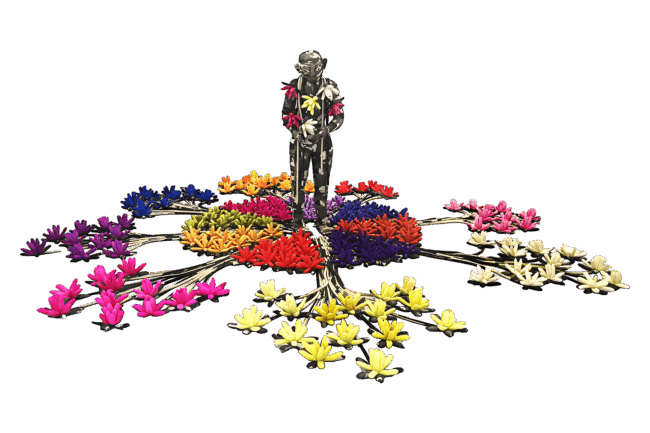 In Yell and Silence, Svay Sareth reflects on his own portrait as a 13-year-old child growing up in a refugee camp after Cambodia’s civil war. The figure, dressed in camouflage, holds a delicate waterlily—a flower deeply rooted in Cambodian cultural memory. This juxtaposition embodies the tension between violence and fragility, between the scars of war and the yearning for peace. The camouflage covering the body recalls a childhood marked by conflict, loss, and displacement. Yet the gesture of offering a waterlily evokes both innocence and resilience. For Sareth, the flower becomes a symbol of a yell—an outcry against violence that stole his childhood and dreams—and at the same time, an offering of silence: a gift of peace carried home to his mother as an exchange for freedom. This intimate act marked the beginning of his understanding of what freedom truly means. Yell and Silence thus stands as both a personal testimony and a universal statement, transforming memories of war into a call for peace, healing, and the preservation of human dignity.
English Audio
2. ASURA SUNFLOWER
 In Siem Reap, a mythological Khmer figure takes form in camouflage fabric filled with kapok. The Asura, half-god, half-demon, here embodies both internal and collective conflicts. Through his choice of materials, Svay Sareth suggests that the most significant battles sometimes arise from heavy silence and broken dialogue.
English Audio
3. THE CHILI CROWN

A colorful, spicy crown composed of chili, wood, and metal. A symbol of both power and burn, it extends the reflection on forced silence, inner fire, and the tension between restrained expression and controlled flamboyance.
English Audio
4. GOLDEN DEVA

In Siem Reap, a contemporary divine figure takes shape in military fabric and kapok filling. This Deva, a benevolent deity in Khmer tradition, is draped here in the memory of war and silence. Through the softness of form and the roughness of material, Svay confronts grace and tension, transcendence and the weight of history.
English Audio
5. THE PILLARS 01 OF THE YEAR ZERO

Presented at the SM Art Center in Siem Reap, this piece initiates a memory project around “Year Zero,” a term made widely known through the writings of François Ponchaud. It subtly evokes the external strikes that drove the country into chaos. A sober way to question the invisible, often distant, causes of internal collapse. These pillars do not mark a beginning, but a rupture, a fracture in historical continuity.
English Audio
6. ADIEUX D170 | MARDI

While pursuing a degree at an art school at Caen, France, Svay staged an intimate farewell: a silent performance focused on the body, movement, and separation, in which the main character uses Mardi, a sculpted boat the artist himself crafted in Normandy from reclaimed wood. Pushed toward the sea, Mardi becomes a voluntary, simple, and powerful act as a way to reconnect with the impulse of departure and the idea of inner freedom.
English Audio
7. GET OUT NEW YORK

In New York, the so-called “land of freedom”, Svay attempted a performance centered on emancipation, but he was stopped in his tracks in under three minutes. A brief, striking action that reveals the paradoxes of controlled liberty.
English Audio
2013-Ongoing Project
8. SM WARNING HOUSE SERIES

Rooted in the precarious experience of refugee life, the SM Warning House series embodies a deeply intimateand instinctive act of resistance. Built from salvaged and recycled materials, each structure becomes a fragile yet intentional shelter, a direct response to systems of control and hostile environments. It all began in 2013 in New York, when Svay discovered a surveillance camera in his studio. Disturbed by the intrusion, he built a makeshift shelter using whatever was at hand, symbolically reclaiming his privacy. This inaugural gesture sparks a series of constructions scattered across the world. In 2024, Warning House #7 was installed at the SM Art Center in Siem Reap. It reflects the precarious housing found in refugee camps where Svay lived for thirteen years. A shelter both open and transitional, it embodies a living memory of instability and adaptation, reaffirming a form of freedom rooted in survival instinct and restored dignity.
Series Installations of WARNING HOUSE:
* Warning House #1 — 2013, New York, USA
* Warning House #2 — 2013, Gwangju Museum of Art, South Korea
* Warning House #3 — 2015, ZKM, Karlsruhe, Germany
* Warning House #4 — 2016, Winner Best Emerging Artist at Prudential Eye Awards Exhibition, ArtScience Museum, Singapore
* Warning House #5 — 2017, France
* Warning House #6 — 2017, Batia Sarem Gallery, Siem Reap, Cambodia
* Warning House #7 — 2024, SM Art Center, Siem Reap, Cambodia
English Audio
9. RISING FROM THE ASHES

This cathartic work highlights a fundamental confrontation: that of destruction and life. A brilliant flower emerges from a bed of ashes and charcoal, in a landscape scarred by fire and ruin. In this scorched setting, it grows quite literally on the tomb of violence. The flowers assert themselves with bold, vivid, almost insolent colors. They challenge the darkness of the soil, a luminous response to the burned matter. The latter, reduced to dust and silence, becomes nothing more than a dark base, a background overshadowed by the triumphant brilliance of the flowers, which, by extending their roots and petals, cover the ashes and reaffirm the sovereignty of life. As symbols of hope, resilience, survival, but also of pride and renewal, the flowers become a manifesto. These flowers have also become medicine for treating wounds they transcend them. They do not hide in sorrow; they emerge from it, affirmed, alive, irreducible. Svay Sareth infuses this work with a quiet, organic, indomitable force. Here, resilience is not silent—itis radiant, fertile, always victorious. An artistic response that declares that after the fire, beauty can rise again, upright and unbound. And that life, inevitably, always finds a way to retake root.
English Audio
10. THE LAST PILLARS OF THE YEAR ZERO

Last witnesses of a broken cycle, these pillars bear the silence of a nation shaken by decisions made elsewhere. In their frozen verticality, they invite reflection on what, without immediate noise, leaves deep traces. Set in their natural environment, where nature reclaims its space, they suggest a slow transition toward the aftermath, a silent, stable presence, suspended between memory and renewal.
English Audio
11. BOUCLIER | OPÉRATION BOUCLIER

In Caen, Svay Sareth designed a “shield” as an extension of the body in resistance. He explored its wear, its scars, its imprints, each a visible sign of internal struggle. From Caen to Paris, approximately 300 km by bicycle, he puts the shield into motion in a performance of introspective confrontation. Still in France, within this theme of bodily tension and endurance, the performance becomes a ritual of resistance. Through movement, wear leaves physical and mental traces, as so many marks of a memory under construction.
English Audio
12. STAKE OR SKEWER

This wall sculpture, constructed from bamboo poles and seventeen rubber sandals, symbolizes the passage of time and personal endurance. Each rubber sandals represents a year that the artist Svay Sareth spent in a refugee camp, marking his journey of self-reflection and resilience. Through this work, the artist transforms ordinary materials into profound symbols of memory, evoking Cambodia’s dark and painful history. The piece serves as a poignant reminder of past suffering and a call to ensure that such tragedy is never repeated.
I, SVAY SARETH, EAT RUBBER SANDAL
A rural area life style, facing the camera, Svay Sareth eats a pair of handmade sandals crafted from used tires, a model emblematic of the Khmer Rouge era. Through this radical gesture, the artist summons both his personal history and the collective memory of a regime marked by violence, doctrine, and dispossession. By ingesting this object loaded with symbolism, Svay transforms endurance into confrontation, submission into provocation, and legacy into open-ended questioning. A performance as physical as it is mental, where the past is embodied and swallowed.
English Audio
13. MON BOULET

Svay Sareth undertakes a symbolic and physical performance over seven days. He drags a heavy 80 kg metal ball across more than 300 kilometers, between Siem Reap and Phnom Penh. This act of endurance becomes a bridge between the sacred ancient capital of Angkor and the modern capital in motion. The performance symbolized Cambodia’s unresolved historical trauma, the weight of personal and collective memory, and references to Khmer Rouge forced labour.
English Audio
14. EAT

Installed in Cambodia, this immersive piece explores how a simple act of eating varies in name depending on social status. Through this variety of terms, Svay highlights a language that categorizes, ranks, and isolates. A sharp critique of a verb that prioritizes defining position over nourishing the collective.
English Audio
15. BEYOND SUNFLOWER

Behind the Mask, A face that hides the light, a personal smile striving to turn toward brightness. In this performance video, artist Svay Sareth experiments with becoming a Sun flower an act of resilience and grace, while attempting to please the gaze of others under the weight of constant observation. Yet, behind the dazzling light, the mask that conceals his true face also becomes a suffocating barrier. What begins as play transforms into a strategy of survival and artistic expression, a continuous search for existence within one’s own identity. Realizing that he has been disguising reality, the artist finally removes the mask and follows the sound of his inner voice. This act becomes his only possible path, allowing him at last to breathe freely, liberated and sincere in his ongoing journey to rediscover the self and remain true to his cultural identity.
English Audio
SM MUSEUM MAP
Frist & Second FLOOR

YIM MALINE
1. DINETTE

A set of emotional games by Yim Maline is scattered across fragments of dust whose origins remain uncertain. Yet, they appear as shadows—sometimes emerging from the artist’s fingerprints—gradually forming into delicate, haunting shapes filled with an undercurrent of violence and threat.
The ceramic knives, seemingly harmless, embody an invisible tension. Arranged with deliberate precision, they reflect the hidden menace and fragility of childhood—one disrupted and displaced by historical turbulence. What may seem like simple daily gestures are, in fact, the artist’s solitary rituals. Within this quiet repetition lies a fragile tenderness, uncertain and wavering, balanced precariously between play and confrontation.
English Audio
2. DECOMPOSITION

What may seem fragile never truly disappears; instead, it transforms in form and essence. Gradually and delicately, lines dissolve, fragments fade, and what remains turns into smaller, parallel traces. Time performs its role like a gentle stream, flowing with quiet persistence. Each mark appears as an act of surrender—yet the process never truly ends. The work continues to evolve, shifting toward a state of calm and quiet resilience.
English Audio
3. MICRO ORGANIC

Subtle traces emerge like tender sprouts piercing through worn and weathered materials. These delicate presences flicker gently patient, resilient, and full of life. Their gestures invite contemplation, manifesting presence through attentive observation. The hidden forms gradually reveal themselves fragile yet stirring evoking the persistence of memory that resists erasure and destruction.
English Audio
4. BACK TO US

The atmosphere feels dense—filled with floating, drifting particles. These delicate forms respond to breath, warmth, and invisible tension. Influenced by emotion and rain, some appear vivid while others thicken, stained and clouded. Like water carrying suspended residues, they reflect ecological traces and the imprints of human actions. The artist refines the work over time, shaping it through the act of stitching—an intimate process of making form. The viewer is invited to step into a realm of spiritual beauty, where the intangible becomes tactile, a sensorial encounter that stirs emotion. It is not a recollection, but a return to depth to something meaningful, resonant, and open to interpretation.
English Audio
5. EXPLOSE

The artwork “Explosion” demonstrates the concept of destruction and rebirth, where form, energy, and emotion converge into a singular, quiet force. Through the technique of charcoal drawing, the artist creates a sense of tension and internal control. The central point, tightly bound, fractures into light, symbolizing life on the brink of transition from darkness to illumination. “Explosion” is not a depiction of an actual explosion but rather an interpretation of the inner energy of life, emerging from silence and contemplation. Through this artwork, the artist transforms the meticulous movement and emotions of charcoal drawing into a breath of life, embodying the patience and power of existence that arises from emptiness.
English Audio
6. ONE PLACE, ONE STORY

This vertical installation rises like towering buildings: light filters through fractured gaps, cascading as if over surfaces that once bore tension and intensity, now softened by warmth. Each fabric panel, each delicate fiber, contributes to layered interactions, as if narrating the memory of a place that is never fully fixed—an eyewitness account of cultural impact and structures long forgotten. It is not a singular story but a woven narrative, intertwining past and perhaps future, especially where the present offers no definitive form. The work does not depict any individual figure; rather, it preserves interstitial moments created by human presence. Some colors are calm, others vibrant, even competing. Yim Malin assembles these discarded materials with care—open, meticulous, and deliberate—creating a space where hardship and joy coexist, a realm of attraction and transformation, where matter and memory converge.
English Audio
7. ARTIFICIAL ESTHETIC
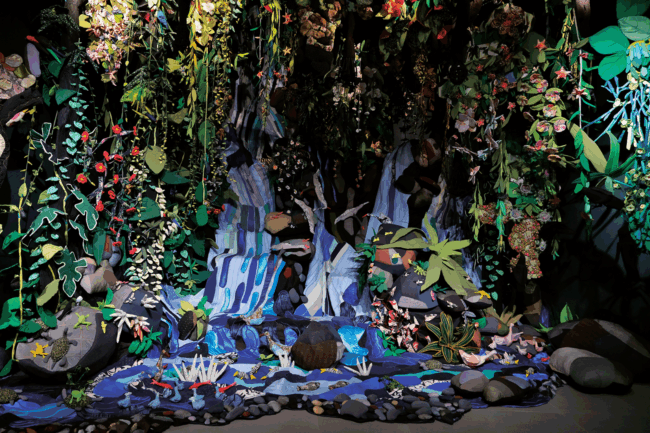
Multiple pieces of fabric, each in varied hues, flow into the space bending, curling, intertwining, and shifting with currents that seem to have no fixed end. This arrangement evokes the landscape of a forested ravine: imagined yet grounded in a clear reference. Over more than five years, the artist, Yim Malin, has collected discarded, weathered materials, each panel bearing traces of past use. The frayed textiles are granted a second life not erased, but transformed, reshaped, and preserved in new forms. Hand-stitched and carefully composed, these fabrics create a harmonious, tactile serenity. The work never truly concludes; it breathes, evolves, and continues to live. Within this continuum, no part ever halts. Everything exists in a process of becoming, raising the question: how—and when should it ever be considered complete?
English Audio
8. NO ONE TO TAKE CARE

A moment held in suspension. No protector, no gesture returned. The composition unfolds like a quiet drizzle: steady, unresolved. Shadows stretch like forgotten intentions. What lingers is not emptiness but the imprint of care never received. It waits, motionless, for something long denied.
English Audio
9. WITH WELLNESS

Well-being here is uncertain. Pencil lines float and overlap, barely holding shape. Each mark hints not at peace but at a delicate balancing act, a continuous effort to stay upright. The drawing hums gently, revealing an emotional terrain on the verge of collapse.
English Audio
10. HAVING EMPTY SPACE

This emptiness holds weight. Not a gap, but a threshold. A surface charged with potential. Maline leaves areas untouched, allowing them to resonate. What appears missing may actually be arriving. It is not loss, but the hush before emergence.
English Audio